🎶 These Are a Few of My Favorite Things (Exercises, of course!)

Updated: Oct 1
If you know the song, you’re already smiling — and that’s exactly the energy I want to bring to this week’s blog. Because exercise doesn’t have to feel like a chore. Sometimes the most powerful things we can do for our bodies are also the simplest, and once you understand why they matter, you’ll want to make them part of every single day.
So here, in the spirit of Julie Andrews, are a few of my absolute favorite exercises — and why I keep coming back to them again and again.
The Triple Stretch — Hip Flexors, Hamstrings & Calves (Gastroc/Soleus)
Picture this: you’re reaching for something, taking a big step, or simply walking down the street — and your body moves freely, without pulling or tightness at the back of your legs or the front of your hips. That’s what keeping your hip flexors, hamstrings, and calf muscles (the gastrocnemius and soleus) stretched can give you.
These muscles are connected in more ways than most people realize. The hamstrings run along the back of the thigh, the calves along the back of the lower leg, and the hip flexors — particularly the iliopsoas — run from the lower spine down through the pelvis to the top of the thigh. Together, they govern how freely and efficiently you move with every single step. And they are among the first to tighten when we spend long periods sitting or become less active. When any one of them shortens, the others feel it too — and so does your posture, your walking pattern, your lower back, and your risk of injury.
Why it matters:
Tight hip flexors pull the pelvis forward into an anterior tilt, which compresses the lower back, shortens the stride, and makes walking feel labored and effortful. Tight hamstrings pull on the pelvis from the other direction, reinforcing that tilt and adding strain up the spine. Tight calves restrict ankle movement, which directly affects balance and how safely and efficiently we walk. These three muscle groups work as a team — and when all three are supple and responsive, the whole body moves better.

The runner’s stretch, also known as a standing lunge stretch, is my favorite way to target all three at once.
Here’s how to do it
Step one foot forward and one foot back, keeping both feet flat on the floor and your back leg straight. Hold onto a wall or sturdy surface for support. Lean gently forward into the front leg, keeping your back heel pressed firmly into the ground. You'll feel a deep stretch through the calf of the back leg — and if you hinge slightly at the hip, you'll also feel the hamstring of that back leg lengthen beautifully.
Hold for 30 seconds on each side, repeating 3 times per leg. Breathe steadily throughout. For a deeper calf stretch, slightly bend the back knee while keeping the heel down — this targets the soleus, the deeper of the two calf muscles. Never bounce. Gentle and sustained is always the goal.
And here's the bonus: with the back leg extended behind you, the hip on that side is in extension, which is precisely the position that stretches the hip flexor. So in one simple, standing movement, you are simultaneously lengthening the calf, the hamstring, and the hip flexor of the back leg. Three for one. That's why I love it.

Simple. Effective. Underrated. Heel and toe raises are one of those exercises that look almost too easy — and then you feel them working exactly where you need them most.
Rising up onto your toes (heel raises) strengthens the calf muscles and the small stabilizing muscles of the ankle. Lifting your toes off the ground (toe raises) targets the muscles along the shin — the tibialis anterior — which play a crucial role in controlling how your foot lands with each step.
Aim for 10–15 repetitions of each, building gradually. Hold a surface for support as needed.
Why it matters:
Strong calves and ankles are your first line of defense against falls. Every time you take a step, your ankle has to absorb your body weight and propel you forward. Every time you navigate an uneven surface, a curb, or a slippery floor, it's the strength and responsiveness of these lower leg muscles that keep you upright. Heel and toe raises build exactly that strength — and they can be done at the kitchen counter, waiting for the kettle, or during the ad break — no equipment needed.

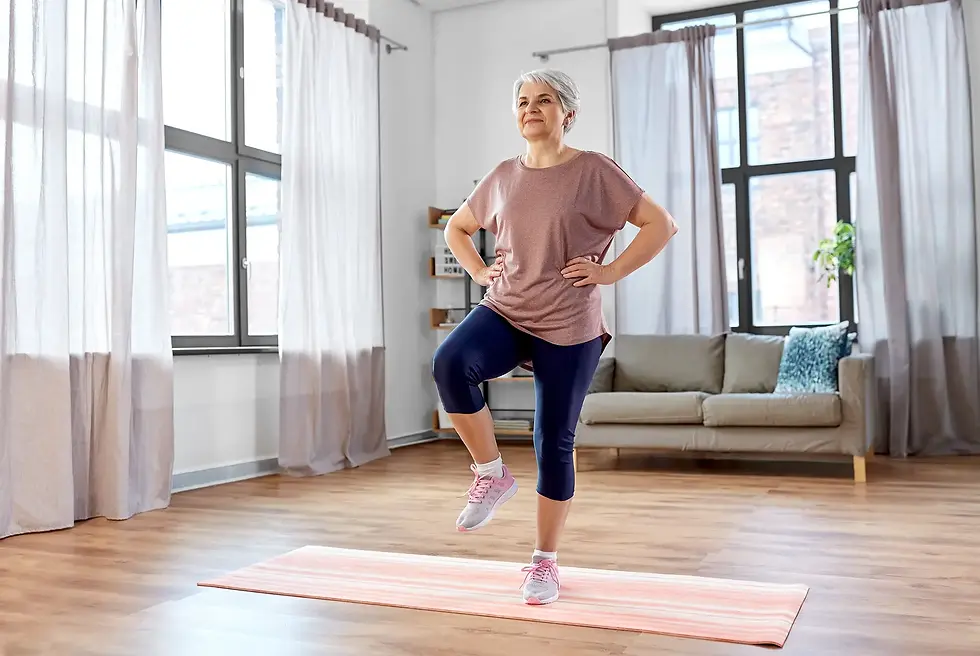
This one is a favorite for a very specific reason: it mimics real life more closely than almost any other exercise.
Here’s something most people don’t realize — when you walk, you are on one leg for approximately 40-50% of every stride. Every single step requires your body to balance, stabilize, and transfer weight on a single foot for a fraction of a second. Over thousands of steps a day, that adds up. And if your single-leg stability isn’t up to the task, every one of those moments is a small fall risk.
Start near a wall or sturdy surface. Aim to hold for 10 seconds on each side, working toward 30 seconds as your confidence grows. Quality over duration — a steady 10 seconds beats a wobbly 30.
Why it matters:
Practicing single-leg stance builds the strength and neuromuscular coordination needed for safe, confident walking. It trains the hip abductors, the ankle stabilizers, and the deep core muscles that keep you upright. It also sharpens the conversation between your brain and your body — improving reaction time and the automatic adjustments that prevent stumbles and trips before they happen.
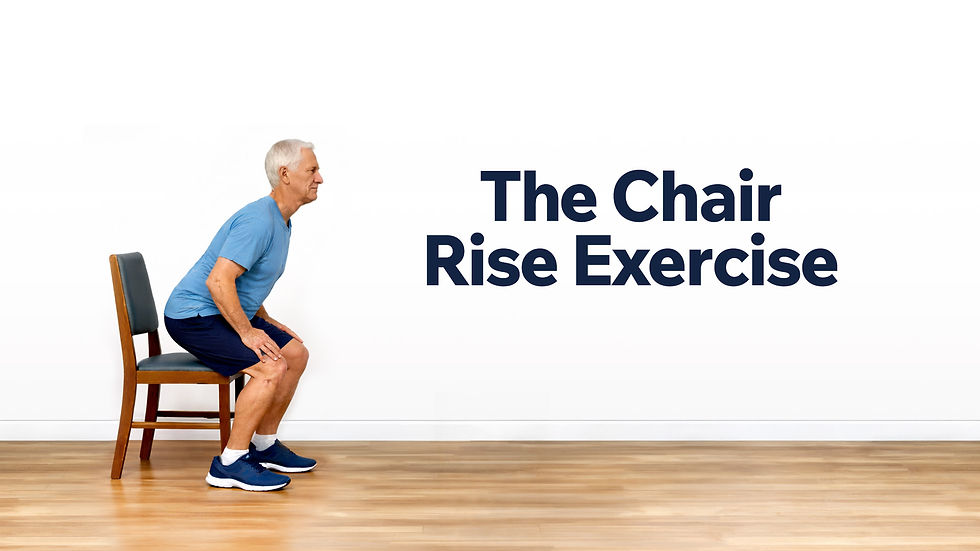
Last but never least… the humble chair rise. Don’t let its simplicity fool you. This is one of the most functionally important exercises there is, and I recommend it to almost every client I work with.
The chair rise — standing up from a seated position without pushing off with your hands — is a direct measure of lower limb strength, balance, and functional independence. In fact, researchers have used sit-to-stand ability as a predictor of long-term health outcomes and fall risk. It tells me a great deal about how someone is actually moving through their daily life.
Sit toward the front of the chair, feet hip-width apart. Lean slightly forward — “nose over toes” — and push through your feet to stand. Lower yourself back down slowly and with control. The lowering phase is just as important as the rising. Aim for 10 repetitions.
Why it matters:
Think about how many times a day you move from sitting to standing — from chairs, sofas, car seats, toilets. Each of those transitions requires strength in the quadriceps, glutes, and core, as well as the coordination to shift your weight forward and push through your feet. When this movement becomes difficult or unsafe, independence quietly starts to erode. Practicing the chair rise regularly keeps this essential movement strong, safe, and automatic.
The Common Thread
You might have noticed something these four exercises share: they all prepare your body for real life. Not performance. Not competition. Just the ability to move through your day with strength, steadiness, and confidence — to get up when you need to, walk where you want to go, and feel secure in your own body.
That’s what Mindful Mobility is all about. And that’s why these are a few of my very favorite things.
Want to learn how to incorporate these exercises safely into your routine? Get in touch with Mindful Mobility — I'd love to help you move better, every day.


